Production From grove to bottle - the NIRÓU way
slow, considered, and without shortcuts.
The Olive
We work only with high-grade olives selected for their exceptional polyphenol content. Polyphenols are the naturally occurring compounds in extra virgin olive oil responsible for the oil's characteristic bitterness and pepperiness and for the protection they are known to offer to blood lipids from oxidative stress, as recognised by the European Food Safety Authority and authorised under European Commission Regulation (EC) No 432/2012.Polyphenol concentration is highest in young, early-harvest olives. This is why timing the harvest, days, not weeks,makes the difference between ordinary olive oil and something worth talking about.The Harvest
Olives intended for NIRÓU are harvested at early maturity, before full ripening. At this stage, the fruit is lower in oil yield but significantly higher in polyphenols, antioxidants, and aromatic complexity. It is the harder, less commercially expedient choice and exactly the right one. Harvesting is carried out with care to minimise bruising and oxidation of the fruit. From the moment of harvest, time is the enemy of quality: olives begin to oxidise and ferment almost immediately. Our production partners work with strict controls on the time between picking and pressing, typically within hours.Cold Pressing
NIRÓU extra virgin olive oil is produced exclusively by cold mechanical extraction the first cold press. No heat, no chemicals, no solvents. The olives are crushed into a paste and spun in a centrifuge at controlled low temperatures (below 27°C) to separate the oil from the water and solids. This process preserves the oil's natural polyphenols, flavour compounds, and nutritional integrity. Cold-pressed extra virgin olive oil is, by definition, the unrefined, unprocessed product of the olive fruit, as close to the grove as a bottle can be.Testing and Quality
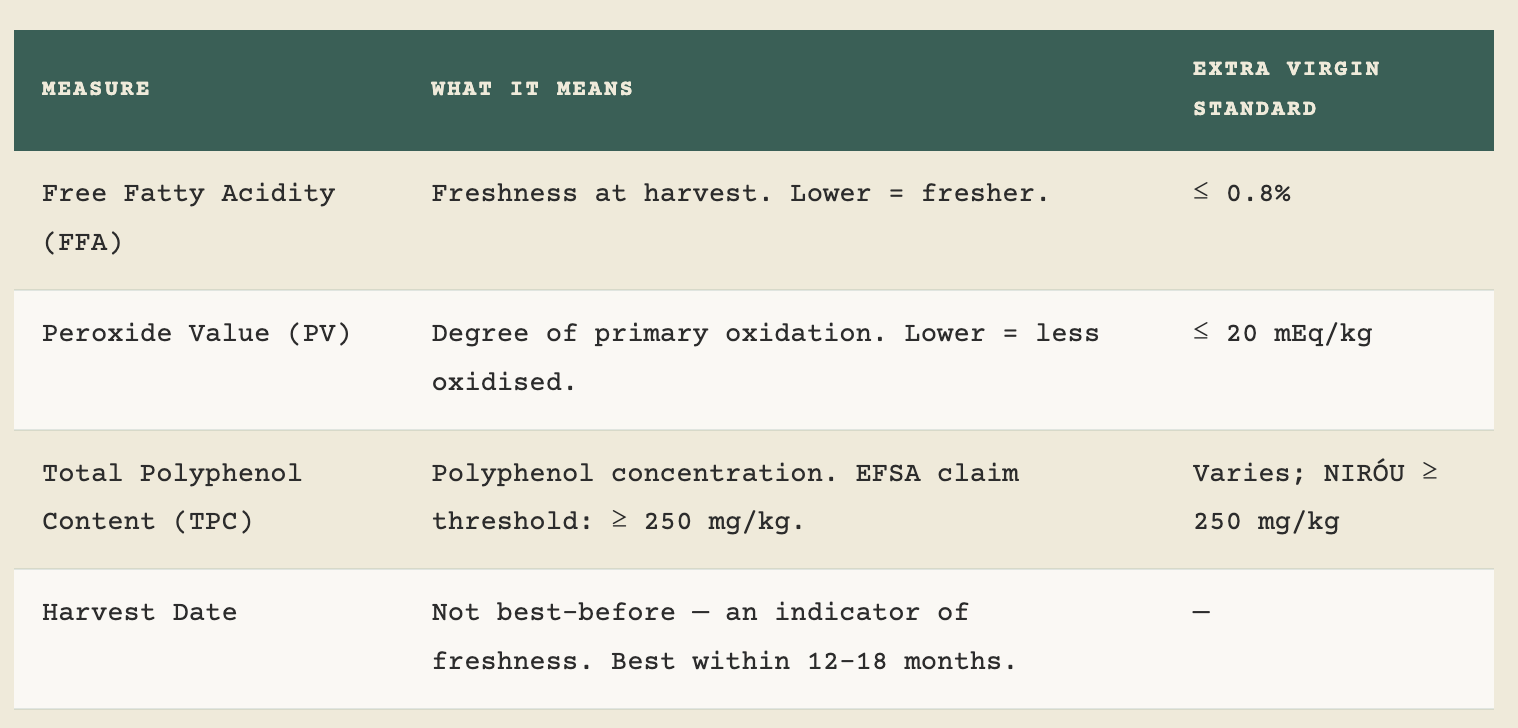
Every batch of NIRÓU is tested before release.
Bottling and Packaging
NIRÓU is bottled in dark glass to protect the oil from light degradation one of the primary causes of quality loss in olive oil. Bottles are sealed with tamper-evident closures and labelled with the harvest date, producer region, and polyphenol content where applicable.We do not add preservatives, additives, or flavourings. What is in the bottle is exactly what came from the olive.A note on health claims
NIRÓU does not make therapeutic claims. Any reference to polyphenol benefits reflects the authorised EU health claim: "Olive oil polyphenols contribute to the protection of blood lipids from oxidative stress" (EC Regulation No 432/2012, applicable to oil providing ≥ 5 mg of hydroxytyrosol and its derivatives per 20 g). NIRÓU is a food product, not a medicine.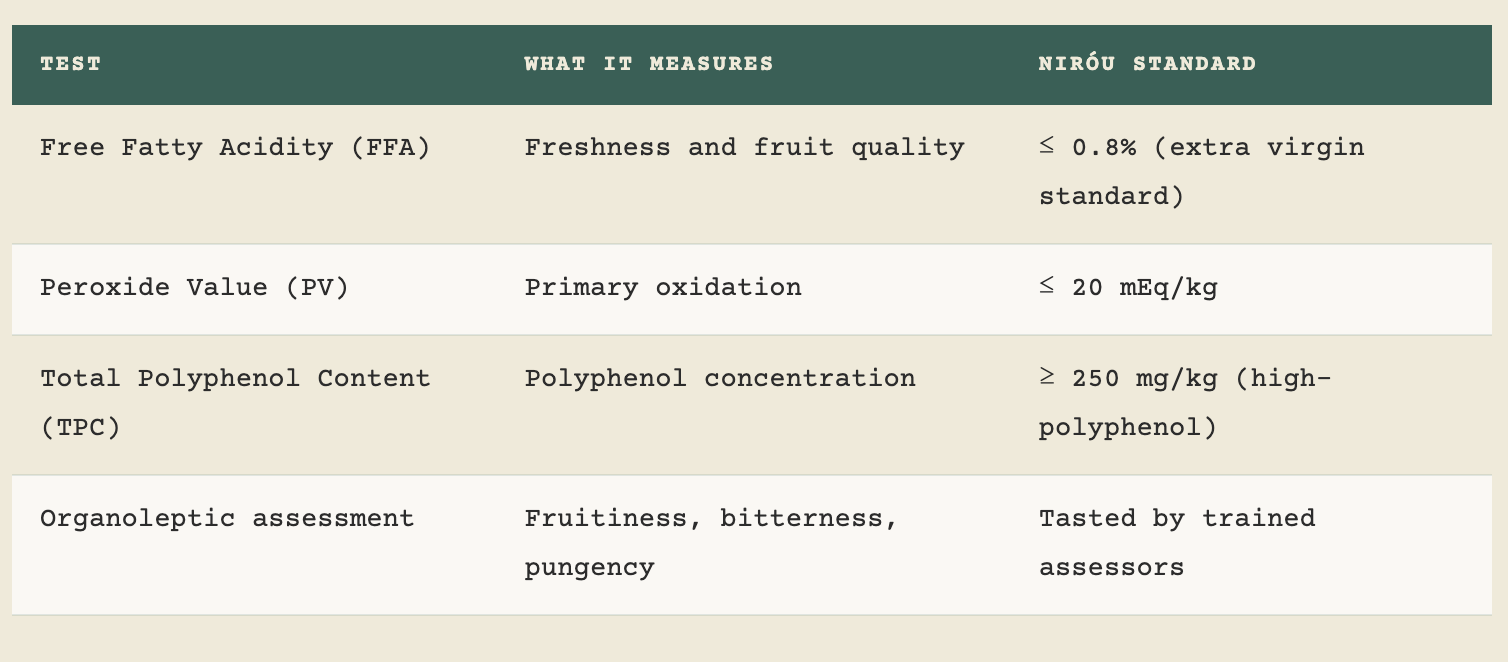
ProcessingWhat happens at the mill
from the grove to the mill, as quickly as possible.
Why Processing Speed Matters
From the moment an olive is picked, its chemistry begins to change. Enzymes activate, sugars ferment, and phenolic compounds start to break down. The polyphenols and antioxidants that give high-quality extra virgin olive oil its character and its nutritional value are at their peak in freshly harvested fruit.This is why the interval between harvest and pressing is one of the most important variables in olive oil production. Long delays, poor storage, or elevated temperatures during transport can all compromise the final oil before a single drop has been pressed.Cleaning and Preparation
On arrival at the mill, olives pass through a leaf and debris separator, then through a washing stage using clean, cold water. Only whole, fresh olives enter the process, damaged, overripe, or fermented fruit is removed at this stage.Crushing
The cleaned olives skins, flesh, and pit are fed into a crusher which breaks the fruit into a coarse paste. The pit is included: it contributes to bitterness and helps the oil release from the cellular structure of the flesh.Temperature is monitored continuously. Cold processing means the paste is kept below 27°C throughout.Malaxation
The crushed paste moves to a malaxer a slow, paddle-driven mixing chamber where it is gently worked for 20 to 40 minutes. This allows microscopic oil droplets to coalesce into larger ones, making extraction more efficient.Malaxation time and temperature are a key quality lever. Shorter and cooler preserves more polyphenols and fresh aromatics. We choose quality over yield.Centrifugation
The paste moves to a horizontal centrifuge that spins at high speed, separating oil from water and solid pomace by density. The oil fraction then passes through a vertical centrifuge for a final clean separation.No solvents. No heat treatment. Nothing added. The result is raw, unfiltered extra virgin olive oil vivid green-gold, hazy with fine particles, alive with the flavour and chemistry of the fruit.Filtration
Some NIRÓU batches are lightly filtered to extend shelf stability. Filtration removes fine suspended solids and water that, over time, cause unfiltered oil to cloud and eventually turn. Where available, we offer unfiltered oil closer to the mill, with more immediate complexity and clearly label it as such.Understanding the Numbers
A Living Product
Olive oil is not a shelf-stable commodity. It is a perishable agricultural product with a life cycle. Keep NIRÓU away from heat and direct light. Seal it after each use. Use it within 12 months of opening.Treat it the way it was made, with a little care.